Found this article to be really wonderful and hence thought of putting it up here.
http://www.yesmagazine.org/new-economy/poverty-global-trade-justice-and-the-roots-of-terrorism
Poverty, Global Trade Justice,
And The Roots Of Terrorism
By John Perkins
16 November, 2009
Yes Magazine
The following is adapted from Hoodwinked: An Economic Hitman Reveals Why the World Financial Markets Imploded—and What We Need to Do to Remake Them. Random House, 2009.
Navy Seal snipers rescued an American cargo ship captain unharmed and killed three Somali pirates in a daring operation in the Indian Ocean on Sunday, ending a five-day standoff between United States naval forces and a small band of brigands in a covered orange lifeboat off the Horn of Africa.
The New York Times published that article in April 2009. The very words "pirates," "daring operation," "standoff," and "brigands" were typical of the U.S. media; they made it sound as though white-hated cowboys had ridden to the rescue of a town besieged by Billy the Kid and his gang. Having lived in that part of the world as an economic hit man, I knew there was another side to what had happened. I wondered why no one was asking about the causes of piracy.
I recalled my visits with the Bugi people when I was sent to the Indonesian island of Sulawesi in the early 1970s. The Bugi had been infamous pirates since the time of the East India companies in the 1600s and 1700s. Their ferocity inspired returning European sailors to discipline their disobedient children with threats that "the bugiman will get you." In the 1970s, we feared that they would attack our oil tankers as they passed through the vital Strait of Malacca.
I sat with one of their elders on the Sulawesi shore one afternoon. We watched his people build a sailing galleon, known as a prahu, much as they had for centuries. Like a gigantic beached whale, it was high and dry, propped upright by rows of gnarled stakes that resembled roots sprouting from its hull. Dozens of men hustled about it, working with adzes, hatchets, and hand drills. I expressed the concerns of my government to him, intimating that we would retaliate if the oil lanes were threatened.
The "terrorists" I have found in Andean caves and desert villages are people whose families were forced off their farms by oil companies, hydroelectric dams, or "free trade" agreements, whose children are starving, and who want nothing more than to return to their families with food, seeds, and deeds to lands they can cultivate.
The old man glared at me. "We were not pirates in the old days," he said, his bushy white hair bobbing indignantly. "We only fought to defend our lands against Europeans who came to steal our spices. If we attack your ships today, it is because they take the trade away from us; your ‘stink ships' foul our waters with oil, destroying our fish and starving our children." Then he shrugged. "Now, we're at a loss." His smile was disarming. "How can a handful of people in wooden sailing ships fight off America's submarines, airplanes, bombs, and missiles?"
A few days after the rescue, the Times ran an editorial entitled "Fighting Piracy in Somalia" that concluded:
Yet left to its own devices, Somalia can only become more noxious, spreading violence to its East African neighbors, breeding more extremism and making shipping through the Gulf of Aden ever more dangerous and costly. Various approaches are being discussed, such as working through Somalia's powerful clans to reconstitute first local and then regional and national institutions. These must be urgently explored.
Nowhere did the Times-or any of the other media outlets that I read, heard, or saw-attempt to analyze the roots of the problem in Somalia. Debates abounded about whether to arm ships' crews and send more Navy vessels to the region. There was that vague reference to reconstituting regional and national institutions, but what exactly did the author mean by that? Institutions that would truly help, like free hospitals, schools, and soup kitchens? Or local militias, prisons, and Gestapo-style police forces?
The pirates were fishermen whose livelihoods had been destroyed. They were fathers whose children were hungry. Ending piracy would require helping them live sustainable, dignified lives. Could journalists not understand this? Had none of them visited the slums of Mogadishu?
Finally, NPR's Morning Edition on May 6 aired a report from Gwen Thompkins; she interviewed a pirate who went by the name Abshir Abdullahi Abdi. "We understand what we're doing is wrong," Abdi explained. "But hunger is more important than any other thing."
Thompkins commented, "Fishing villages in the area have been devastated by illegal trawlers and waste dumping from industrialized nations. Coral reefs are reportedly dead. Lobster and tuna have vanished. Malnutrition is high."
You might think we would have learned from Vietnam, Iraq, the "Black Hawk down" incident in Somalia back in 1993, and other such forays, that military responses seldom discourage insurgencies. In fact, they often do the opposite; foreign intervention is likely to infuriate local populations, motivate them to support the rebels, and result in an escalation of resistance activities. That was the way it happened during the American Revolution, Latin America's wars for independence from Spain, and in colonial Africa, Indochina, Soviet-occupied Afghanistan, and so many other places.
Blaming pirates and other desperate people for our problems is a distraction we cannot afford if we truly want to find a solution to the crises confronting us. These incidents are symptoms of our failed economic model. They are to our society the equivalent of a heart attack to an individual. We send in Navy Seals to rescue the hostages, as we would hire doctors to perform a coronary artery bypass. But it is essential to admit that both are reactions to an underlying problem. The patient needs to address the reasons his or her heart failed in the first place, such as smoking, diet, and lack of exercise. The same is true for piracy and all forms of terrorism.
Our children's futures are interlocked with the futures of children born in the fishing villages of Somalia, the mountains of Burma (Myanmar), and the jungles of Colombia. When we forget that fact, when we see those children as remote, as somehow disconnected from our lives, as merely the offspring of pirates, guerrillas, or drug runners, we point the gun at our own progeny as well as at the desperate fathers and mothers in lands that seem so far away but in reality are our next door neighbors.
Every time I read about the actions we take to protect ourselves from so-called terrorists, I have to wonder at the narrow-mindedness of our strategy. Although I have met such people in Bolivia, Ecuador, Egypt, Guatemala, Indonesia, Iran, and Nicaragua, I have never met one who wanted to take up a gun. I know there are crazed men and women who kill because they cannot stop themselves, serial killers, and mass-murderers. I am certain that members of Al Qaeda, the Taliban, and other such groups are driven by fanaticism, but such extremists are able to recruit sizable numbers of followers only from populations that feel oppressed or destitute. The "terrorists" I have found in Andean caves and desert villages are people whose families were forced off their farms by oil companies, hydroelectric dams, or "free trade" agreements, whose children are starving, and who want nothing more than to return to their families with food, seeds, and deeds to lands they can cultivate.
In Mexico, many of the guerrillas and narcotraffickers once owned farms where they grew corn. They lost their livelihoods when the North American Free Trade Agreement (NAFTA) gave subsidized U.S. producers an unfair price advantage. Here is how the Organic Consumers Organization, a nonprofit that represents more than 850,000 members, subscribers, and volunteers, describes it:
Since NAFTA came into effect on January 1, 1994, U.S. corn exports to Mexico have almost doubled to some 6 million metric tons in 2002. NAFTA eliminated quotas limiting corn imports . . . but allowed U.S. subsidy programs to remain in place-promoting dumping of corn into Mexico by U.S. agribusiness at below the cost of production. . . . The price paid to farmers in Mexico for corn fell by over 70 percent. . .
The passage above exposes the dark side of "free trade" policies. U.S. presidents and our Congress have implemented regulations that prohibited other countries from imposing tariffs on U.S. goods or subsidizing locally grown produce that might compete with our agribusinesses while permitting us to maintain our own import barriers and subsidies, thus giving U.S. corporations an unfair advantage. "Free trade" is a euphemism; it prohibits others from enjoying the benefits offered to the multinationals. It does not, however, regulate against the pollution that is melting glaciers, the land grabs, and the sweatshops.
Father Miguel d'Escoto Brockmann, a Nicaraguan priest who ministered to Sandinista guerrillas and is now president of the U.N. General Assembly, has a firsthand appreciation for such euphemisms and the power of words used to sway public perceptions. "Terrorism is not really an ‘ism,' " he told me. "There's no connection between the Sandinistas who fought the Contras and Al Qaeda, or between Colombia's FARC and fishermen turned pirates in Africa and Asia. Yet they are all called ‘terrorists.' That's just a convenient way for your government to convince the world that there is another enemy ‘ism' out there, like communism used to be. It diverts attention from the very real problems."
Our narrow-minded attitudes and the policies that result from them foment violence, rebellions, and wars. In the long run, almost no one benefits from attacking the people we label as "terrorists." With one glaring exception: the corporatocracy.
Those who own and run the companies that build ships, missiles, and armored vehicles; make guns, uniforms, and bulletproof vests; distribute food, soft drinks, and ammunition; provide insurance, medicines, and toilet paper; construct ports, airstrips, and housing; and reconstruct devastated villages, factories, schools, and hospitals-they, and only they, are the big winners.
The rest of us are hoodwinked by that one, loaded word: terrorist.
The current economic collapse has awakened us to the importance of regulating and reigning in the people who control the businesses that benefit from the misuse of words like terrorism and who perpetrate other scams. We recognize today that white-collared executives are not a special, incorruptible breed. Like the rest of us, they require rules. Yet it is not enough for us to reestablish regulations that separate investment banks from commercial banks and insurance companies, reinstate anti-usury laws, and impose guidelines to ensure that consumers are not burdened by credit they cannot afford. We cannot simply return to solutions that worked before. Only by adopting new strategies that promote global environmental and social responsibility will we safeguard the future.
John Perkins adapted this excerpt of Hoodwinked: An Economic Hitman Reveals Why the World Financial Markets Imploded—and What We Need to Do to Remake Them for YES! Magazine, a national, nonprofit media organization that fuses powerful ideas with practical actions. John is also the author of Confessions of an Economic Hit Man, The World is as You Dream It: Shamanic Teachings from the Amazon and Andes, and Spirit of the Shuar.
Thursday, November 19, 2009


Sunday, May 03, 2009
Kamalamba Navavaranams

Why don’t people sing Kamalamba Navaavaranams during music festivals around the world? Why don’t we hear them as loud and consistent as Thyagaraja’s Pancharatna Krithis? The Pancharatnas have acquired celestial fame that, even several film music composers snuggled them by bits and pieces, into movie songs and background music over past many years (no disrespect intended)! They even have the reality show competitions, exclusively for Pancharatna singing by kids !
I have asked this question at several Carnatic music festivals and got universally the same answer, that nobody knows to sing them which implicitly means that they are not famous enough for people to put in efforts to learn them. Thank god, nobody answered this explicitly, that they are not as attractive as the Pancharatnas.
This is some sort of a disease particularly of the contemporary society. Things untouched go into garbage very easily and it requires a celebrity’s touch and at times, sincere effort, to pick them onto the showcase. For instance, this happened with the pre-trinity Tamil composers’s songs among which many were, as much I understand, brought into limelight by the humble efforts of Sanjay Subramaniam, after several decades of appalling neglect.
I have equivalent and unanimous admiration for the Trinity and comparing them for their ‘merit’ is much more ridiculous a business than comparing apples and oranges. But stylistic and musical differences are obvious for their compositions. Thyagaraja’s krithis, as I see them, were more spontaneous in creation and hence huge in number. I have heard legible opinions that a huge number of his krithis disappeared forever into history, since his disciples couldn’t get a chance to note them down, while they were sung by him. Many krithis were contemplative and philosophical apart from the central theme of divine worship. He was perhaps the most diversified composer ever in the musical history, that you could end up using all adjectives of your vocabulary to describe his music.
But Dikshitar’s was to a very certain extent, more scholastic with emphasis on deriving the maximum linguistic beauty, though the central theme was the same; divine worship through comprehensive description of the corresponding God/Goddess. His enormous knowledge bank of mythology, history, geography, temples and architecture all evidently glitter in each and every krithi. The scholastic nature coupled with the Vilamba Kaala of his compositions, to me, appear the reasons for his lesser fame among the masses. It is interesting to note that while Pancharatnas are sung all the year round irrespective of the occasion, the Kamalamba Navavaranams are rarely sung even during the Navarathri period, when they are supposed to be sung. Not to mention Dikshitar’s other set of krithis like Abhayamba Navavaranam, Neelothpalamba krithis, Navagraha Krithis, Panchalinga Ksetra krithis etc.
Man has always had this attraction for speed that, anything slow or silent or subtle will stay in the junkyard. Apathy that MDR had received during his life time makes a good parallel with the lesser projected glory of Dikshitar krithis.
Well, it’s time to keep my moaning and criticisms apart…Right now I am melted in the Anandabhairavi of “Kamalamba samrakshatumam” by DKJ and his chorus; the person, to my knowledge, who immortalized the Navavaranas (DKP too).
Saturday, August 23, 2008
Where the blood became white

I have learnt in my high school biology that cockroaches and some other creatures have white blood. But let me tell you, human beings can also have white blood. What if a man is stabbed and the redness of the blood made white through some intelligent optical manipulation? If that is done on every person stabbed (and possibly announced in CNN or BBC) the world will slowly start believing that blood is white. Is it not?
And there was an emperor in
Ok, let me end this rhetoric here….That emperor was none else than Shah Jahan, who amputated the hands of some 20,000 workers, who constructed his ‘white building’, called the Taj Mahal. This is the monument which declared that human blood could be white. Some historians (probably the western historians who first elevated this white building with a criminal background, to one of the seven wonders of the world) advocate that Shah Jahan cut only the main mason’s hand(s) of; that too his right hand alone. Hmm…what an intelligent consolation!
Anyways, even I don’t know the truth. Regardless of the quantity of hands, I ought to believe this widely known fact. I can’t afford to make myself disbelieve this genocide just because the world around me cherishes the Taj as the ostentatious archetype of love.
For me, this is a brutal tragedy; a red-handed truth of human massacre; a totally unnecessary and very much avoidable killing, just executed for the sadistic advantage of petty human ego and selfishness. Added to that comes the colossal loss of the rich artistic and cultural heritage of that time, through the elimination of those artists. None of the history text books known to man might mention this; for the history is just a story written and publicized by the powerful and the successful.
The Taj is not the symbol of love; but of the vicious annihilation of love; for, love by any definition means, not the self centered love constrained to the familial boundaries comprising of one’s wife, children or to a few selected people within the limited range of one’s perception. To love a wife and to murder (yes cutting the hands is equivalent to murder, to me and I am sure that most of them would have just perished; because they wouldn’t have been able to work without their two hands to find enough food to keep themselves alive!!!) 20,000 others, for the selfish (which is often portrayed as the greatest and unique merit of Taj Mahal!!!) motive of maintaining the uniqueness of the Taj is the greatest atrocity in disguise, I can ever manage to find in the history of mankind, I have known about.
For me, Shah Jahan was just a brutal murderer and a cold-blooded perpetrator of human genocide, who doesn’t hold the minimal eligibility to be presented by the history as the magnanimous constructor of the marble monument epitomizing human love. It is one of the biggest faults of the Indian and the world history to have not demoted the name of that person to the notorious list comprising of Hitler, Idi Amin, Narendra Modi and the infinite others. And it is one of the biggest ironies in the behavioral history of human beings that, the world enjoys and glorifies the whiteness of this monument and consciously or ignorantly shut their eyes and heart towards the red-naked truth of the blood that would have covered the entire Agra, when the 40,000 hands, trembled with their last life and played the rhythm of the most horrible form of death. But the avalanche of their tears would have swept the lava of their blood away, facilitating the hands of power to imprint their euphoric stories about the Taj onto the minds of the insensitive and illiterate world outside; a world which can function only on the stories of the powerful and the successful; a world of human beings whose existence itself is a quintessential function of the gallons of blood shed since the advent of mankind. Yes, this ‘bloody’ Mahal will cast its cruel white glow forever to overshadow the periodic red bloodsheds on this planet...It was created to cheer at the great American genocide of the red Indians, the genocides in Armenia, Cambodia, Rwanda, Bosnia, Nanking, Ukraine, Nandigram, Godhra and Iraq, the two big world wars, 2008 Olympics in China and whichever going to happen to sustain the future of mankind. It will exist forever to proclaim this ‘blood’y eternal truth about man and mankind.
Courtesy: To Amit, for an (lazy) afternoon discussion on this topic.
Sunday, June 01, 2008
Reading Kundera

Reading Kundera has ever been a self-discovering experience for me. Excuse me for talking more about myself, while the title, bears the name of one of the greatest philosophers ever lived and gives the impression of a discussion about his style of writing and other artistic and humane virtues.
I should say that it has been more of self-reflective in nature than a discovery by itself. I am the same human being, I was before reading Kundera. SO it is more of a self-reflective experience. Being listened is a very individualistic desire in every human being, I believe. Sadness occurs when one is not heard or listened to, by anyone around him/her.
Life has taken me to a new environment; New human beings, new culture and strange things happening around…The mortal bindings of love has made it impossible to talk with the loved ones, many of the bare truths of life. It might take many years, till I gain the familiarity of human beings in my new habitat, who would listen to me and whom I would listen to. The desire to talk my heart out, has been growing, with increasing pressure. The world around me has diversified and the people have changed; their needs have changed; many among who had been in my life are busy traversing in the new realms of their life. The world is running in time, and ideas which don’t talk about euphoria, development and success, are generally not heard. Nevertheless I can’t blame anyone for not listening to me! It is a very helpless situation.
There came Kundera to my rescue. When I read him, I read my mind; a conversation with myself.. a very slow conversation without any haste, or constraints of time..a conversation well listened to, properly interpreted, so as to obtain maximum satisfaction..
In this process, I discover a similitude of thought process between mine and Kundera's. As for any human being, I too started getting the satisfaction that many of what I have been thinking about were all not mere waste of time and thoughts; but that there had been many immortals who wrote, sung and played with the thoughts similar in emotion to mine, though of obvious superiority and strength in quality.
I discovered that the negative qualities like pessimism, sadness, etc have their significance and the whole world is shadowed in the so called positive qualities, while in reality, it is immersed in sadness. That is the truth. Yes, Kundera helped me see and feel the bare truths of life; which often, we human beings neglect to acknowledge.
I have never seen any other writing as strong as his (you can count on my limited familiarity to world literature). His is the writing that redefines the concepts of morality, which is often a man-made set of rules, created for his own convenience to simultaneously practice immorality and preach morality. He explores the meaning of love, which is invisibly binded to the mortal pleasures of human consciousness. His writings are the truth incarnated. The truth in its total nudity…this truth is bold..it is the strongest atom bomb, I believe... It can break apart anything, a relationship; a culture; a race...
Still my desire for being listened continues with its fullest pressure. It may make me do the strangest things in my life. Quite recently I have discovered music to be incapable of helping in an explicit communication with the souls around us, with whom we wish to communicate. Music has many limitations like religion, rules, culture and tradition, which arrests its degrees of freedom….
To be contd…
Saturday, April 26, 2008
Palghat Mani Iyer

Another melancholy evening...Thoughts about mridangam and Palghat Mani Iyer, churned out musical emotions in me…If ever I could have changed the destiny of my birth to a few years earlier. I would have at the least landed on this earth, when PMI had been alive.
If I had consistently thought about anything in my life, with utmost sincerity and it would have been about Palghat Mani Iyer and his glory; the history which created him and the history which he created. Thousands of things to be said about him; to be glorified, without a scintilla of exaggeration; thousands of anecdotes, potential enough to drive an atheist to a believer in the “Mani iyer’ God; Yes, He was the God of Rhythm incarnated;the impeccable idol; an immortal visionary of music and art. To me, he is the frame of reference for everything; every music, every art...
In one of his very few public speeches, (Padmashri felicitation for MDR) the reticent Mani Iyer said, “The job of a musician is a difficult one. If you want to score a rank in your school sudies or so, you can work hard for a few months and succeed. But if you don’t play well today, it will be said that you played well yesterday, but not today. So the job of a musician is a difficult job, that involves an examination on a daily basis. So there is only one way to succeed in it. Keep thinking about the great people. So you will ask me, ‘
Our rational intuition will be to state that one can never become a great artist if he keeps thinking about great people instead of doing dedicated and meticulous practice. But I believe that, adoration is what is primarily; for a mridangist, the finger will obey him once he can adore a great mridangist sincerely. Talent is in a way a state of unconsciousness when you don’t know what you are doing, but undoubtedly, you are doing the best. If you can measure what you do, it is not talent. A genius doesn’t know that he is a genius, that’s why he is called a genius.
To be contd….
(A writing experience of full personal satisfaction, will require many days of thinking and editing. It creates a big void in consistency in writing, when I wish to make an article appear perfect to me; use the best words to bring out the charisma of the personality, whom I talk about; So I guess it is better to post out the scribblings, so atleast a momentary satisfaction is gained, even though the article remains unfinished and immature. It’s like a movie shot in a single take; but it has it’s own beauty I believe.
The ‘to be contd’ should excuse my discontinuity in thoughts and inconsistency in writing due to innate sluggishness.
Saturday, June 16, 2007
Torch-bearer of the Tanjore Bani*

Today when culture, music and the lifestyle on the whole are forsaking their identity so as to assume a dodgy globalized temperament, artists who sincerely follow that 'hard' path of maintaining the individuality of their traditional artistic styles are undoubtedly of immense value for the cultural heritage of this country. In this regard, Sri Kodunthirapully Parameswaran has stamped a forte by being a faithful follower of the great Tanjore bani of Mridangam, which he belongs to.
Parameswaran's artistic lineage can be traced back to the Tanjore bani. His grandfather Late Sri Kondunthirappully Swaminatha Iyer, a close comrade of Palghat Mani Iyer, learned the art initially from Tanjore Ponniah Pillai and later from the great Tanjavur Vaidynatha Iyer, himself. The strong foundation of rhythm laid in him by the painstaking training of his grandfather, amply prepared him for the gurukula training from Sangeethakalanidhi Dr TK Murthy, himself the greatest living exponent of the Tanjore school. The golden period of twelve years of gurukulam under Sri Murthy was a turning point in his professional career as a mridangist. He faithfully served and followed his Guru like a shadow and earned outstanding scholarship and experience by playing double mridangam concerts with his Guru. He also had tutelage under Sri Parassala Ravi, which he gratefully recalls to have helped him expand the horizons of his artistic imagination.
Parameswaran's style of performance is highly innovative and vibrant with brisk and uncannily fitting 'cholkettus' and 'mukthayis', epitomizing his ardent loyalty to his school. His ineffable accompaniment standards immensely embellishing such krithis as "Amba Kamakshi" (Bhairavi swara jathi) are indeed instances of supreme artistic virtuosity. He has a perfect mastery over the very difficult fingering techniques of his Guru which brings in pristine clarity of each and every stroke on the mridangam. This, it must be remembered, is a characteristic aesthetic beauty of the Tanjore bani His direct connection to the Tanjore school through his veteran teachers, also helped him understand the much extinct fingering methods and contributions of other early generation laya exponents like Ponniah Pillai, Azhaganambi Pillai, Palani Subrahmanya Pillai, Palghat Mani Iyer etc. In short, it is no exaggeration to term him the authentic ready reference dictionary of the Tanjore school. Apart form nurturing several young vocalists and instrumentalists on the stage, which he earnestly regards as his birth-objective, Parameswaran has earned laudable accolades by accompanying several senior artists like KV Narayanaswamy, TN Seshagopalan, TK Govinda Rao, TV Shankaranarayanan, Trichur Ramachandran etal.
Among the contemporary mridangists, Parameswaran stands out exceptionally unique for his excellent faculty in "Konnakol", a vocal tradition of reciting rhythm, which nowadays, is on its last legs. He inherited this special talent from his Guru, who himself had been inspired by the konnakol performances of the great Pakiriya Pillai of Tanjore. This is a remarkable feature of his teaching in which he has got an innately high caliber. His vivid and perfect rendition of konnakol helps the students to earn a strong basis of rhythm and learn the rhythmic patterns in an impeccable manner. Today there are a handful of prospective students who approach Parameswaran to get specifically trained in his grand style.
In the contemporary music and cultural scenario when cheap gimmickries like record breaking marathon performances and media hyped stories happen to be the shortcuts to cheap stardom and the indexes of musical and cultural merit, the noteworthy but unvoiced contributions of such eminent but habitually reticent artists as Parameswaran, will remain unnoticed and our national heritage entail a colossal loss, unless the art and music lovers congregate time, patience and perseverance to learn, practise, realize and appreciate the vastness and the profundity of our rich cultural legacy.
Sankar
Saturday, June 09, 2007
Individuality and Success
Is life a trade off between individuality and success? The ironies I have been experiencing and observing around me, have forced me come into terms with the fact that individuality and success don’t coexist, in the best of their degrees
I have come across several real-life and fictional characters with strong individuality and some other successful people with good individuality but often diplomatically comprising to the situations favoring their public acceptance or appreciation. History talks about several such heros, in music, in art forms, in literature, in research, and in other realms of life.
What I try to imply by the term, Success, is the general appreciation or the glory conferred upon a person by the system or the society of which he is a part of, since it’s a highly relativistic term.
I have often wondered why some people maintain their strong individuality in all occasions. Probably because they have a self appreciation and the strong feeling of satisfaction about their quality of being uncompromisingly individualistic. And for them they may be certainly the most successful and satisfied folks on the earth. Or sometimes they may not be even caring to think about the meaning of success.
An artistic figure whom I respect much for his individuality is none else than Palghat Mani Iyer. How Mani iyer, maintaining in tact his strong individuality and tacit straight forwardness, could get renowned as a great starlwart by the people in common and simultaneously by the most knowledged, is something that always fascinates and perplexes me. But that is moreover an empirical truth which none could/can ever deny. Needless to mention is the truth that, his fame and glory were not something he earned in a day or two; much unlike the present day Guinness bookers or the Big brothers who shoot into immortal vainglory within a few days of public gimmickry. During MDR’s Padmasri award felicitation ceremony, Mani Iyer noted, “Never play for the masses. Instead, train them to hear and appreciate what we play”. I sincerely doubt whether there is any artist today, who have the guts to proclaim and adhere to this.
Another embodiment of individuality is the Varadadasar, Sri MD Ramanathan. He is, I would say, the man who gave a new definition for the term, ‘individuality’ in carnatic music. Much obviously, his was not such a colorful life in terms of glories and stardom.
The movie Fountainhead (based on a novel by Ayn Rand) comes to my mind in this context. The protagonist, an architect by birth and profession, is a quintessence of strong individuality. His uncompromising zeal for getting the buildings constructed strictly based on his designs, without any negotiation for aesthetic appeal and fame, makes him grossly an unsuccessful person. And in a tough situation of his life, when another architect pleads with him to use one of his marvelous designs, he agrees to it without demanding even a single dough as compensation, strictly on the condition that the construction be made exactingly according to his plan. But later when he finds that his condition has been neglected he intrepidly ventures to blast down the construction!
The list of such figures is endless. In Carnatic Music itself if I can cite the names of several such great artists as TK Murthy Sir, Palghat Raghu Sir… how many more such purists would have immortalized their niche in other forms of music, performing arts, literature, sciences and philosophies of other nations, other civilizations…It was nothing else for their undiluted faith in their meritorious creations, that they stood for. It was that confidence of them, the purists, to surpass all the powers of social doctrines based on superficiality and ignorance. Their contributions were out of the ample time they made found for themselves unlike their mediocre counterparts, who might have probably wasted their time in getting themselves preached.
My earnest salutations to all the masterminds, especially for the ones whose names are unknown to us just because they weren’t interested in getting their names carved on the sands of history. It would have been nice if our society, to the least, took care not to term them, appallingly as ‘gandhians” or ‘idiosyncratic brats’ if not try to become eligible and meritorious enough to realize and acknowledge their contributions.
Monday, February 19, 2007
The Valentine's day
This year, as usual, the Valentine’s Day made a huge hue and cry, with a mega increase in the pomposity of celebrations, and subsequent increase in the number and strength of hollow protests by political parties and organizations which claim themselves as the moral police ‘meant’ for the prevention of social evils.
Hearing the term Valentine’s day, arouses in me no more than a contemptible laughter, pitying the necessity of a unique day to express one of the basic emotions of human beings called LOVE. Emotions are simply instantaneous and unpredictable phenomena. It is hard to compel oneself to evoke emotions. Emotional joy or ecstasy comes out of inner contentment, which may have various triggering factors in various individuals. I wonder how people can derive inner joy when they receive some ready made roses or greeting cards with the boring romantic clichés encrypted in a jargoned fashion. This time, as I understand, there have been a number of ‘innovative’ but fundamentally absurd and ridiculous ways celebrating V day. Thanks to the media and the corporate, who have with them the power to make anything sane or insane.
Why do we need a separate day to express our love to our loved ones? Do we need a Mother’s day, Father’s day or sister’s day? Does that mean that we don’t love them on other days? These are some of the obvious logical questions against the credibility of the V day. Love is in the work you do to earn a living, love is there when you give your seat in a crowded bus to an old man, love is there when you switch off the fans and lights of your workroom after your use, love is there when you put a blasting metal music in a low volume, so as not to disturb your neighbors! Love is something ubiquitous in everything you see, in everything you do, in everything you think. Love is about the sensitivity of our hearts, it is about how we respect and care to bother for our fellow beings, how we identify the emotions and ethos of others with ours. Just that love has different forms and manifestations depending on the individuals, situations they encounter and the relations they maintain.
Anyway I don’t enforce anyone to regard my concepts of love as universally true. The least I can or shall do is just keep myself away from celebrating the Vday, so as to happily uphold and feel satisfied about the principles I believe in.
Though I find the whole idea of V day obscurely ludicrous, I defend the right of an individual to celebrate it. I have to acknowledge the existence of such individuals who derive pleasure and satisfaction from celebrating the Vday. Hence I pity the politicians and the conservative jingoists who bark like dogs trying to invite the whole attention to their stubborn ideology which they foolishly advocate to be solely universal. It is a well known fact, but a rarely respected fact, that the constitution provides each and every citizen the right to celebrate any festival in whatever way he/she likes, provided it does not debilitate the right of his/her fellow citizen. Such a fundamental right existing, I wonder why those political scoundrels are not arrested by law, for harassing and hampering the constitutional rights of others. What eligibility do they have to proclaim themselves as the custodians of our culture and heritage? Why don’t they target the bollywood heroes and babes who have been playing the significant role, in redefining the whole concept of ‘Indian’ness and Indian culture and legitimizing extreme boundaries of love and sex?
Be it fortunate or unfortunate, I believe that, all these changes are simply the habitual results of a large scale influence of westernization and globalization phenomena. Whether we need such a superficial amalgamation of cultures and social customs is a question too profound to answer. Today when westernization is the only criterion that wholly defines development and prosperity in all fields of Indian life, the popularity of the V day sentiments among the middle class Indian youth doesn’t give any special surprise. But what I plead to ask is, don’t we have enough number of indigenous festivals that uphold the concepts of love and prosperity? Don’t we have myriads of prestigious classical and traditional art forms, dance and music, that calls for love and peace, perhaps in a more subtle and respectable manner?
Westerners don’t have any similar fests and when they celebrate the V day they may be probably, quite sincere and contented about it. They are in a different cultural domain of emotional expression and formality where such a unique day can’t be regarded as something preposterous. But when it is celebrated in India, it largely becomes a vainglorious symbol of artificiality and meaninglessness, lacking emotional sensitivity and faith. It becomes just another opportunity for the market forces to play upon and extract the maximum profit from their prey; the middle class youth who in their bloated euphoria don’t care to ponder over such issues with profound social and cultural implications.
So this cycle of celebrations and protests will continue in the years to come. It is an everlasting battle between the contrasting interpretations of Indian culture and modernism.
Hearing the term Valentine’s day, arouses in me no more than a contemptible laughter, pitying the necessity of a unique day to express one of the basic emotions of human beings called LOVE. Emotions are simply instantaneous and unpredictable phenomena. It is hard to compel oneself to evoke emotions. Emotional joy or ecstasy comes out of inner contentment, which may have various triggering factors in various individuals. I wonder how people can derive inner joy when they receive some ready made roses or greeting cards with the boring romantic clichés encrypted in a jargoned fashion. This time, as I understand, there have been a number of ‘innovative’ but fundamentally absurd and ridiculous ways celebrating V day. Thanks to the media and the corporate, who have with them the power to make anything sane or insane.
Why do we need a separate day to express our love to our loved ones? Do we need a Mother’s day, Father’s day or sister’s day? Does that mean that we don’t love them on other days? These are some of the obvious logical questions against the credibility of the V day. Love is in the work you do to earn a living, love is there when you give your seat in a crowded bus to an old man, love is there when you switch off the fans and lights of your workroom after your use, love is there when you put a blasting metal music in a low volume, so as not to disturb your neighbors! Love is something ubiquitous in everything you see, in everything you do, in everything you think. Love is about the sensitivity of our hearts, it is about how we respect and care to bother for our fellow beings, how we identify the emotions and ethos of others with ours. Just that love has different forms and manifestations depending on the individuals, situations they encounter and the relations they maintain.
Anyway I don’t enforce anyone to regard my concepts of love as universally true. The least I can or shall do is just keep myself away from celebrating the Vday, so as to happily uphold and feel satisfied about the principles I believe in.
Though I find the whole idea of V day obscurely ludicrous, I defend the right of an individual to celebrate it. I have to acknowledge the existence of such individuals who derive pleasure and satisfaction from celebrating the Vday. Hence I pity the politicians and the conservative jingoists who bark like dogs trying to invite the whole attention to their stubborn ideology which they foolishly advocate to be solely universal. It is a well known fact, but a rarely respected fact, that the constitution provides each and every citizen the right to celebrate any festival in whatever way he/she likes, provided it does not debilitate the right of his/her fellow citizen. Such a fundamental right existing, I wonder why those political scoundrels are not arrested by law, for harassing and hampering the constitutional rights of others. What eligibility do they have to proclaim themselves as the custodians of our culture and heritage? Why don’t they target the bollywood heroes and babes who have been playing the significant role, in redefining the whole concept of ‘Indian’ness and Indian culture and legitimizing extreme boundaries of love and sex?
Be it fortunate or unfortunate, I believe that, all these changes are simply the habitual results of a large scale influence of westernization and globalization phenomena. Whether we need such a superficial amalgamation of cultures and social customs is a question too profound to answer. Today when westernization is the only criterion that wholly defines development and prosperity in all fields of Indian life, the popularity of the V day sentiments among the middle class Indian youth doesn’t give any special surprise. But what I plead to ask is, don’t we have enough number of indigenous festivals that uphold the concepts of love and prosperity? Don’t we have myriads of prestigious classical and traditional art forms, dance and music, that calls for love and peace, perhaps in a more subtle and respectable manner?
Westerners don’t have any similar fests and when they celebrate the V day they may be probably, quite sincere and contented about it. They are in a different cultural domain of emotional expression and formality where such a unique day can’t be regarded as something preposterous. But when it is celebrated in India, it largely becomes a vainglorious symbol of artificiality and meaninglessness, lacking emotional sensitivity and faith. It becomes just another opportunity for the market forces to play upon and extract the maximum profit from their prey; the middle class youth who in their bloated euphoria don’t care to ponder over such issues with profound social and cultural implications.
So this cycle of celebrations and protests will continue in the years to come. It is an everlasting battle between the contrasting interpretations of Indian culture and modernism.
Tuesday, July 25, 2006
Tabla and John Abraham
I recieved an interesting scrap in my orkut from a person with profile pic of Johan Abraham(in a written language which can hardly be called English)..I am pasting the scrap and my reply scrap. Let brevity be the soul of wisdom.
Sender: hello sankar..well took me half an hour to glance thru the profile..good one...well am a student doing my final yr electrical enng in guj..i have done visharad in tabla..play for my college band..my uncle plays good mridamgam..i also work with times of india..a reporter..cover the city news to campus buzz etc..well i wanted some good hands with hindu r any magzines whr i can contribute and thy pay u also..since u r more exp do let me know..i also breath eat and sleep music.! but tabla is a bit outdated na boss?..so u try any fusion? like a guitat with tangam.?..and do lend me good websites whr i can do a research in music..rest on the journalism side i really need ur help..nice to meet u.
My reply scrap : Dear friend, you called tabla an outdated one... will you call Newton's laws of motion an outdated one? Shall we think of a fusion programme with John abraham dancing on the tabla?
Sender: hello sankar..well took me half an hour to glance thru the profile..good one...well am a student doing my final yr electrical enng in guj..i have done visharad in tabla..play for my college band..my uncle plays good mridamgam..i also work with times of india..a reporter..cover the city news to campus buzz etc..well i wanted some good hands with hindu r any magzines whr i can contribute and thy pay u also..since u r more exp do let me know..i also breath eat and sleep music.! but tabla is a bit outdated na boss?..so u try any fusion? like a guitat with tangam.?..and do lend me good websites whr i can do a research in music..rest on the journalism side i really need ur help..nice to meet u.
My reply scrap : Dear friend, you called tabla an outdated one... will you call Newton's laws of motion an outdated one? Shall we think of a fusion programme with John abraham dancing on the tabla?
Sunday, July 09, 2006
Music and Competition
While unexcitingly scanning through the TV channels, on a homely Sunday evening, I came across a boisterous debating session, in a popular Malayalam channel, which to my astonishment was apparently a film music competition. It was a verbal fight between some among the audience and the judge. One of the music candidates couldn’t get into the next round. And the judge was sued by the audience for that. In the dramatic turn up of events, the judge decides, to quit the event, the anchors attempts to reconcile the issue and pacify him, while the audience still debated on the issue of a few marks, which could push the candidate into the next round. Finally, the anchors decide to conduct a viewer’s SMS poll and the candidate requests the TV viewers to send SMS supporting her so that she could get into the next round.
This whole pandemonium churned out some thoughts in me on music and competition and that’s what I am going to pen down here.
First of all let me express my innate wonder over the competitions in music. What is music? Whatever form and genre be it… Is it something solely for competitions and marketing? Is it solely for entertainment? Is it something that is to be compared and evaluated? I wonder…
Let me express my deep agony over the society in which I live, where everything is a competition. Education is a competition. Ranks, marks, grades, and later, placements salary, cars, mobile phones, bungalows…Marriage is made a business...Everything is compared. We Indians evaluate people through comparisons alone. We ourselves legitimize everything evil like, dowry, corruption, etc through our own casual approach and silly thoughts.
Coming back, how can we compare the music in and from different individuals? If there is a competition in music, I believe that, it is simply a testimony to the ignorance and the pathetic level of approach of the people towards music. Is there a concept of ‘small’ and ‘big’, in music?
For instance, in a classical music competition how can a judge compare the Thodi and a Sankarabaranam sung by two different candidates? And if both the candidates sing Thodi, how can he compare the two Thodis?
Can you compare Semmangudi’s * Bhairavi with that of MDR*?? Definitely not. Why?? Because their approaches to Bhairavi are different. Their delineations are different in structure and intensity of ‘sangathis’. It depends on their general philosophical outlook to music. The mood Bhairavi generates is different in different individual. The interpretations are different, independent and exclusively original. Their voices themselves are far different. But Semmangudi’s nasal voice and MDR’s basal tone are both beautiful. Both voices have their own kind of taste and charisma. And it was their constant search for their own individuality in music, which produced the ever green music from both. The music woven by Semmangudi in his nasal voice can never be imitated or reproduced. It is his own. It is his copyright. He has put a stamp on his musical identitiy. And that has grown to a style or bani of his own. Same was the case with MDR. It is said that, if two MDRs sat beside each other, to sing, one can’t win over the other!! So much instantaneous and unfathomable was his innovation and originality! Such music was simply from the soul. And every human being has got a distinguished soul for himself. If one can appreciate this concept, he will never allow himself to be compared with someone else and he will never be interested in lauding a music competition.
So, music or art in general is about learning to live as oneself, carving a niche for oneself and sticking to one’s own distinctiveness. Does this get projected in a music competition, where the most common and vociferous film songs are repeated over and over, a thousand times, to create a total mental and physical cacophony? (I can’t opine that the Carnatic Musichood is totally free from such trends)
Nowadays, music broadcasted through the mass media lacks originality. It is by and large, not from the heart. It fails to appeal us (who truly value music), emotionally or intellectually. It is simply a preprogrammed exertion of memory, vocal chords and an inherent ability to imitiate. (I am not generalizing though). It lacks sensitivity, it lacks what we Carnatic musicians call Bhavam. Where is innovation, where is the subtlety? Does it emotionally ignite us somehow? Does it bring in us the sense of serenity and harmony?
When we don’t have sensitivity towards music, we are ready to compromise on anything, we are ready to go for competitions or similar marketing assignments and let our art be compared. In return we earn the false appreciations, from the community we live in… from the corporate world, we work for.
The students are made to see music or painting or dance, as a method to earn prizes and accolades. This is what has been happening in most of the cultural youth festivals in
And why does this happen? Is it because human being is compromising on his humane capabilities and sensitiveness, for an intellectually inert and emotionally barren modern life? Can’t we do something to impede these ‘crimes’ on music and arts in general? Can’t we create a slight progressive development in the attitudes in our fellow Indians?
So, do we still need competitions? Whom are we trying to please by winning a competition, when we fail to please our own soul through our music? Anyway I firmly believe that, unless and until, we Indians, learn to forget the ‘art’ of comparing, we are never going to rise morally or intellectually, though financial accomplishments may come along.
Let me stop by recalling (again?) the definition of music given by MDR
M-Morality, U-Universality, S-Spirituality, I- Individuality, C- Creativity.
Musically,
Sankar
*Semmangudi- Semmangudi Srinivasa Iyer, the bhishmacharya of Carnatic Music.
*MDR – MD Ramanthan, a doyen of Carnatic Music.
Tuesday, May 23, 2006
MDR and the Beatles
I am sure this title evokes no less than a tinge of curiosity among the music lovers, who are familiar with “MD Ramanathan’s music” (more than Carnatic music on the whole). I happened to hear this linking story from Prince Rama Varma (of Trivandrum royal family,an ardent MDR fan and disciple of M Balamuralikrishna), during the official release of a book on MDR named, “Kedaram”, authored by Sri Krishnamurthy, 20th May 2006 (83rd birthday of MDR), at Tripunithara, Kochi, Kerala.
Prince Rama Verma once happened to attend a summit of most renowned poets in English language, at a remote village near
One day Prince happened to meet a gentleman. He was the PA of John Lennon, the most vital member of the Beatles, perhaps, the most avant-garde pop band that brought out revolutionary amendments in the concepts of pop music. Soon he fell in acquaintance and Prince, who was in his traditional attire, introduced himself as an Indian Classsical musician. The PA was moved and he started to share his life stories especially the times when he was with the Beatles. That was undoubtedly the golden era in his life. Money, fame, luxury, and everything known in the materialistic world were at his fingertips. There was absolutely nothing on which they could not lay hands upon.
But soon the flamboyant lives lead the whole Beatles into confusion and misery. They started realizing that they were missing something mystical and numinous in their lives. But they couldn’t correctly spot out the factor. In that state of utter dilemma and predicament, they decided to start their search for the ultimate truth. They started with drugs, later dropped it and tried upon meditation. George Harrison, came to
After the death of John Lennon, the PA went to
Yes this sounds ironical. MDR and the PA!! They were at the two extremes of practical life. The PA, who had had literally all the luxuries and achievements in life, was moved by the depth of the voice of a simple human being in another part of the world, who had lead the most orthodox and traditional musical life. The PA had no idea, what Sahana was, what Kedaram was, what Yadukulakamboji was, what Sriraagam was…He was not aware of the intricacies or the inherent ‘bhava’ of the music. What moved him may seldom be susceptible to a verbal description. But at least this can be stated without uncertainty, that it was the universality of Indian classical music in general and MDR’s music in particular that greatly moved and brought the peace in the consciousness of the PA.
After sharing the experience with the Prince, both of them broke into tears and embraced each other.
So this is what connects MDR with the Beatles.
To talk about MDR’s music is an herculian task, as far as one whole life time is concerned. He himself had defined Indian Music as Morality, Universality, Spirituality, Individuality, Creativity…
How true!!
PS: Comrades who are new to MDR’s music can read more about his immortal music at www.mdramanathan.com
Sunday, May 14, 2006
When the strings stopped singing..
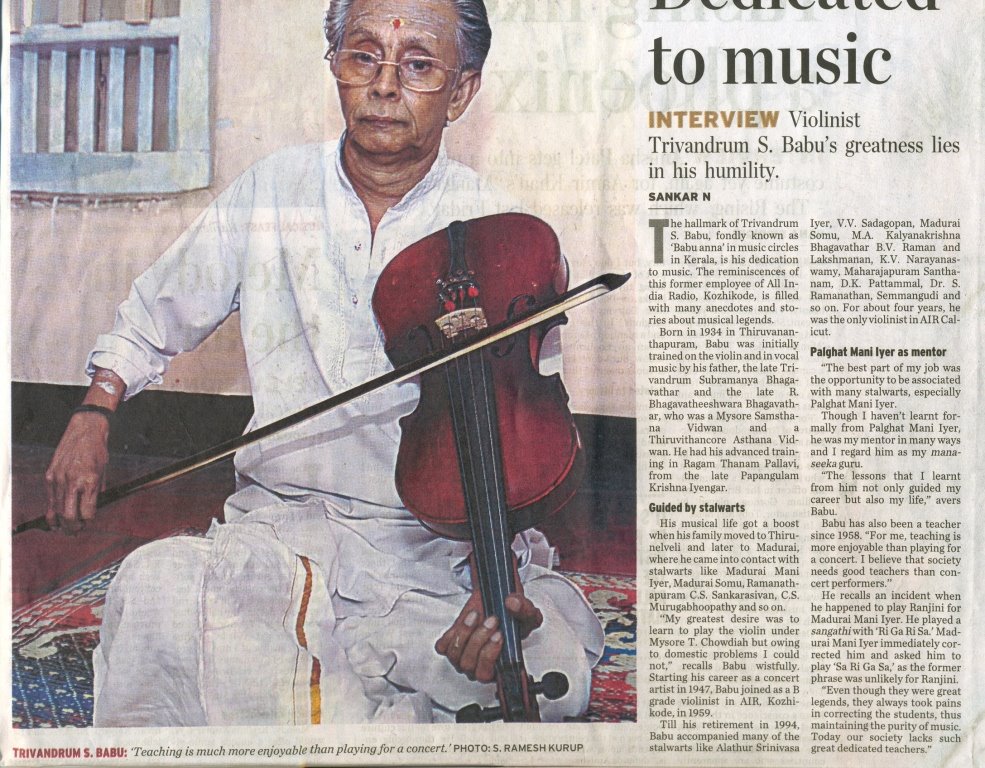
Cursing the sms sound that disturbed my afternoon nap, I got out of the couch and moved towards the phone, without much curiosity. The sms showed, “TS Babu sir expired”. I wasn’t startled. I just took a moment to adjust myself to my senses and the physical world. I rung up Narayanaprakash (a mridangist and usually the source of reliable information) and confirmed. Yes, Babu sir is dead. He was taken to the nearby clinic, in the morning out of uneasiness in breathing. Anyway he, a chronic asthma patient attained an easy death and an easy death is sometimes a great boon, than anything else.
I went to his home, a small, congested two storied house near the Poonthanam Junction. Yes, this house is quite famous among the artists. It is a halting place for all the artists visiting
Sivakumar (his younger son) smiled at me. What an irony! But I could easily sense the deep valley of solitude he was in. Yes, his father was everything for him. His mother had expired long back. I didn’t know what to speak to him; was perplexed whether my words intended to console might go showy for him. I just patted on his back and came out of the house. The sangeetha sabhas of
I sat on the corridor, and slowly got into mild talks with the artists and my friends assembled there. Narayanan (a musicologist and a concert organizer) said, “you wont believe, I was listening to BV Raman & Lakshmanan, kutcheri with Babu sir accompanying them, today morning…they just finished RTP Hamirkalyani, when I saw the news in the TV”.
Before leaving I went inside again. SVS Viswanathan (the ghatom, Mridangam artist and son of SVS Narayanan) was weeping loudly.Yes, Babu Sir was like a father for him. He was telling Sivakumar, “Ennathum samshayam irunthunna ippo kettukko, cholli tharuvar…Konjam kazhinjal poyiduvar..” (If you have any doubts ask andlearn now itself, he will clarify, after sometime he will leave)
Hearing this, my heart started weeping.
The great teacher is dead. Outside the house I talked to Mr Krishnan, an old student of Babu Sir, and an admirer of his music. We talked a lot,..
Yes Babu sir was more a teacher than a performer. The term violinist is something that underestimates his credentials and yeoman service he rendered to music throughout his life. He was simply a great teacher. I haven’t learnt directly from him. Nor had I enouh chances to interact with him much. But I have been seeing and observing him a lot since my childhood. A small lean man, with humility encrypted in his innocent smile, poignantly radiating from his face like the notes of Poorvikalyani.
I wont describe him with the number of awards he got for his service or the grand appraisals he received in his concerts. It is meaningless and sinful to describe so, the great teacher who had structured his own life into a great lesson for his students. He would talk to me with dynamism and passion about his admiration for Palghat Mani Iyer (the emperor of the art of Mridangam), whom he always regarded as his Manaseeka guru. He would talk about Madurai Mani Iyer, whom he earnestly considered as his role model for a teacher.
The greatest failure (if ever it is one) in Babu sir’s life was that he didn’t sell his art. He didn’t earn accolades. He didn’t earn money. His life is nothing more than a silent epitome of the difference between a performer and a teacher.
A performer’s watch word is perfection. Constant practice and perseverance are alone the slogans of a performer’s life. His knowledge is limited, but he knows well whatever little he knows. He knows to present it well for the rasikas. His only feedback is that from the rasikas. Whatever they feel good, becomes his philosophy and style.
A teacher’s primary desire is in enlightening his students. To fully transfer to them whatever he has learnt from his guru. To enable them to judge between right and wrong. To show the right way for his shishyas to learn from nature and other musicians. To inspire their souls towards right learning, to enable them to step into the path of knowledge and wisdom. In the process, the teacher, forgets to sell his art. His livelihood out of music is not a matter for him. He has little time to rest or practice while his students are stepping up through the ladder of his life. His concerts are just unconscious efforts; his experience simply drives him on the stage, and his devotion simply produces the music, from him on the dias. Everything that he produces on the stage are instantaneous and innovative. There is nothing preplanned or programmed. Everything is subtle. He is not afraid of a new innovation going imperfect. Nor is he afraid of mistakes. He is not shy to commit mistakes. He is not worried over an ignorant man questioning his credibility. He makes beauty out of informality.
His comrades and students confer glory upon him. While the rasikas feel his music to be unpleasant, but pleasing them is not his goal. So in the concert, he plays the silent part and walks away with the small remuneration, if he gets any, to teach his disciples waiting for him at his home.
Babu sir was simply a great teacher.
Once he told me, “Playing for ‘arangetrams’ of students are the most joyous events of my life. If you play for Semmangudi, he may not remember you after a month. But if you play for the first concert of a budding artist, he will cherish you forever. And that gives me the real pleasure…” He was a man lucky enough to be born with absolutely no ego.
Once during his childhood, while he was practicing Ranjani at his home in
Babu sir was then amazed by the simplicity of Mani Iyer. Inspite of being the senior most Vidwan of his times, Mani Iyer, was humble and interested enough to correct even a small boy playing a wrong sangathi in the violin. Such was their dedication to the cause of teaching.
Once in a chamber concert in
(“See Babu, he started from where I stopped. And he embellished whatever I sang to a better fashion, so that I get inspiration to sing more and more and there’s a mutual rapport between us. That is what is the dharma of the violinist. Is there anybody in the new generation who accompany like that?”)
It is meaningless to talk more about him, because his life itself was the message he conveyed and observing his life is more important than talking about him. He hasn’t left anything physical. I am stopping with a regret in my mind, “If I could spend one more day with that mahanubhavulu, …entharo mahanubhavulu anthariki vandanamu…”. May his soul rest in peace.
Subscribe to:
Posts (Atom)